Showing posts with label ...Problems with Labor and Delivery. Show all posts

Pregnancy Complications - 5

Gestational Diabetes


It is a glucose intolerance that is first recognized in pregnancy.

Clinical Findings
  • Polyuria
  • Polydipsia
  • Polyphagia
  • Fatigue
  • Blurred vision
  • Glucosuria
  • Recurrent yeast infections
  • Slow healing wounds
  • Abnormal glucose results
    • 1-hour glucose 140 mg/dL
    • Abnormal 3-hour glucose tolerance test: 2 out of 4 values elevated
      • FBS 95mg/dL
      • 1-hour 180mg/dL
      • 2-hour 155mg/dL
      • 3-hour 140mg/dL
Outpatient Management

  1. Dietician consult for ADA diet instructions
  2. Discuss pathophysiology of gestational diabetes with patient
  3. Demonstrate home glucose monitoring
  4. Review range for glycemic control
  5. Demonstrate logging of glucose results
  6. Discuss role of exercise in glycemic control
  7. Demonstrate urine ketone testing
  8. Demonstrate insulin administration
  9. Teach patient to count fetal movements
    • Find comfortable position in quiet place and concentrate on fetal movement
    • Document time of first fetal movement and time required for 10 movements (should not take more than 2 hours)
    • If pattern of movement decreased, REPORT immediately

Pregnancy Complications - 4

Preeclampsia


Preeclampsia is a hypertensive disorder of pregnancy with multi system involvement

Clinical Findings
  • Blurred or altered vision
  • Epigastric pain
  • Headache
  • Edema
  • Proteinuria
  • Hyperreflexia
  • Hypertension
Nursing Care
  1. Closely monitor vital signs
  2. Assess deep tendon reflexes
  3. Dipstick urine for protein
  4. Record presence of edema
  5. Palpate tone of fundus
  6. Auscultate fetal heart rate and apply EFM
  7. Monitor patient comfort
  8. Collect 24-hour urine
  9. Place patient in side-lying position
  10. Keep environment quiet and dim
  11. Institute seizure precautions:
    • Side rails up and padded
    • Bed in low position
    • Suction equipment available at bedside
    • Oxygen available at bedsideInitiate IV fluids as ordered
  12. Monitor intake and output
  13. Initiate medications as ordered

Eclampsia

Clinical Findings
  • Worsening of symptoms of preeclampsia
  • Seizure activity
HELLP Syndrome

Clinical Findings
  • Worsening symptoms of preeclampsia
  • Malaise
  • Epigastric pain
  • Nausea/vomiting
  • Laboratory findings:
  • Hemolysis
  • Elevated Liver enzymes
  • Low Platelets

Pregnancy Complications - 3

Hyperemesis Gravidarum

It is an intractable vomiting in pregnancy with resultant weight loss and dehydration

Nursing Care
  • Assess vital signs
  • Observe for signs of dehydration
  • Review electrolytes
  • Access IV site as ordered
  • Record fetal heart tones
  • Record intake and output
  • Record daily weight
  • Check urine for ketones
  • Administer antiemetics as orderedPreterm Labor

Preterm Labor


It is an onset of regular labor before the 37th completed week of gestation.

Clinical Findings
  • Rhythmic lower abdominal cramping
  • Complaints of backache
  • Increased vaginal discharge
  • Downward pelvic pressure
  • Leaking of amniotic fluid
  • Vaginal spotting
  • Cervical effacement/dilation
  • Shortening cervical length
Nursing Care
  1. Determine gestational age
  2. Assess uterine tone
  3. Auscultate fetal heart tones and apply EFM
  4. Obtain vaginal/urine cultures
  5. Assess for leaking amniotic fluid: Ferning - Microscopically, amniotic fluid will resemble the leaves of a fern plant, and Nitrazine paper - Due to the alkaline nature of amniotic.
  6. fluid, the nitrazine paper will change from yellow to blue
  7. Perform vaginal exam to determine dilation and effacement of the cervix
  8. Position side-lying
  9. Initiate IV fluids as ordered
  10. Administer corticosteroid to mother:  Accelerates maturity of fetal lungs AND Most benefit 24 hours after administered
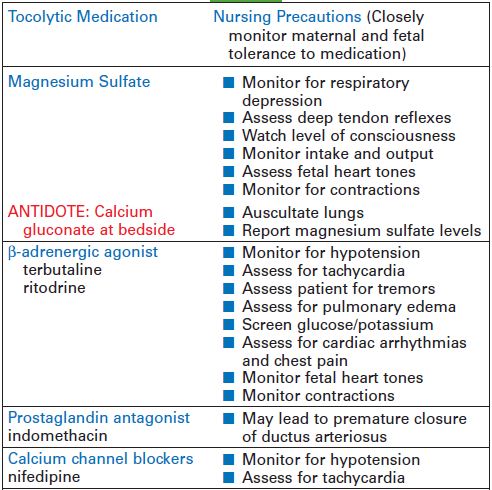
  11. Initiate tocolytic therapy


Pregnancy Complications - 2


Vaginal Bleeding (after 20 weeks’ gestation)

The complications may be related to placenta previa or abruptio placentae.

Placenta Previa
It is a low-lying position of placenta in the uterus that partially or completely covers the cervical os. Clinical Findings:
  • Painless bright red vaginal bleeding
  • Bleeding may be reported after intercourse
  • Uterine tone soft upon palpation
  • Interventions dependent on amount of bleeding and labor status
  • If partial placenta previa is noted in early gestation, then repeat ultrasound later in pregnancy (may demonstrate absence of previa as uterus grows)
  • If labor active and os is covered, then cesarean birth necessary
  • If bleeding controlled and labor absent, then conservative management is applied

Patient Teaching (Conservative Management)
  • No tampon use
  • No sexual intercourse
  • Monitor and report bleeding
  • Patient instructed to report placenta placement when admitted to hospital
  • Cesarean preparation class
  • Count fetal movements


Abrupto Placentae

Clinical Findings
  • Abdominal pain (sudden onset, intense and localized)
  • Fundus firm, boardlike, with little relaxation
  • Vaginal bleeding
  • Bleeding may be concealed within the uterine cavity
  • Fetal heart tones may be non-reassuring
Nursing Care (vaginal bleeding/late pregnancy)
  1. Monitor amount of bleeding
  2. Check vital signs
  3. Observe for signs of shock
  4. Evaluate fetal heart tones
  5. Palpate uterine tone
  6. Apply electronic fetal monitor (EFM)
  7. REPORT alterations in fetal heart rate pattern
  8. REPORT hypertonic contractions with poor resting tone
  9. Do not attempt vaginal exam until placenta placement verified
  10. Initiate IV fluids
  11. Report laboratory and ultrasound findings
  12. Prepare staff for possible cesarean birth
  13. Attend to patient’s emotional needs


Pregnancy Complications - 1

Vaginal Bleeding (before 20 weeks’ gestation)
It may be related to spontaneous abortion, ectopic pregnancy, or gestational trophoblastic disease.

Spontaneous Abortion
It is a loss of pregnancy before viability, clinical Findings:

  • Vaginal spotting (may pass clots)
  • Abdominal cramping
  • Cervical changes
  • Fetal heartbeat may be present or absent

Ectopic Pregnancy
It is a product of conception implant outside the uterus, clinical findings:

  • Vaginal spotting
  • hCG lower than expected for dates
  • Lower abdominal pain
  • Ultrasound findings: absence of intrauterine gestational sac
  • If rupture occurs, it would be: Positive Cullen’s sign (periumbilical bluish hue), Shoulder pain, and Signs of shock

Gestational Trophoblastic Disease
It is an abnormal proliferation of trophoblastic cells without viable fetus, Clinical Findings:

  • Vaginal spotting (dark brown)
  • Fundal height greater than expected for dates
  • hCG greater than expected for dates
  • Excessive nausea and vomiting
  • Absence of fetal heart tones
  • Ultrasound findings: Snowflake-like clusters, absence of fetus

Nursing Care (vaginal bleeding/early pregnancy)

  1. Monitor amount of bleeding
  2. Assess vital signs
  3. Observe for signs of shock
  4. Auscultate for fetal heart tones (FHTs)
  5. Collect passed tissue/clots
  6. Monitor patient comfort
  7. Check blood type and Rh factor
  8. Administer Rh(D) immunoglobulin if indicated
  9. Initiate IV fluids as ordered
  10. Report lab/ultrasound findings
  11. Attend to patient’s emotional needs


Fetal Distress

Fetal distress is a compromise of the fetus during the antepartum period (before labor) or intrapartum period (birth process). It is commonly used to describe fetal hypoxia (low oxygen levels in the fetus).

Fetal distress can be detected due to abnormal slowing of labor, the presence of meconium (dark green fecal material from the fetus) or other abnormal substances in the amniotic fluid, or via fetal monitoring with an electronic device showing a fetal scalp pH of less than 7.2


Signs and Symptoms of Fetal Distress:

Nursing Interventions:

  • Place patient in a lateral position, elevate legs
  • Administer oxygen at 8-10 L/min via face mask
  • Discontinue oxytocin (Pitocin) if infusing
  • Monitor maternal and fetal status
  • Prepare for emergency cesarean section

Supine Hypotensive Syndrome

Supine hypotensive syndrome occurs when the venous return to the heart is impaired by the weight of the uterus. It results in partial occlusion of the vena cava and descending aorta and in reduced cardiac return, cardiac otuput, and blood pressure

Signs and Symptoms:
  • Hypotension
  • Fetal distress
  • Faintness, light-headedness, dizziness


Nursing Interventions:
  • Place patient in a lateral recumbent position
  • Monitor vital signs and fetal heart rate
  • Treat for shock if other signs of shock are present

Amniotic Fluid Embolism

Amniotic fluid embolism is the condition in which the amniotic fluid is escaped into the maternal circulation. It is usually fatal to the mother because the debris containing amniotic fluid deposits in the pulmonary arterioles.

Signs and Symptoms:
  • Respiratory distress and chest pain
  • Seizures
  • Cyanosis
  • Heart failure and pulmonary edema
  • Fetal bradycardia and distress

Nursing Interventions:
  • Emergency action is performed to maintain life
  • Administer oxygen at 8-10 L/min by face mask or resuscitation bag
  • Position patient on side
  • Prepare for intubation and mechanical ventilation
  • Administer IV fluids, blood products, and coagulation therapy
  • Monitor fetal status
  • Prepare for emergency delivery
  • Provide emotional support for patient, partner and family

Uterine Inversion

Uterine inversion is a condition that the uterus turns inside out completely or partly. It usually occurs during delivery or after delivery of placenta.

Signs and Symptoms of Uterine Inversion:
  • Severe pain
  • Hemorrhage
  • Depression in the fundal area
  • Interior of the uterus may be seen through the cervix or protruding the vagina

Nursing Interventions:
  • Monitor for signs of hemorrhage and shock and treat shock
  • Prepare patient to reposition the uterus to the correct position via the vagina or laparatomy if unsuccessful

Placenta Abruptio


Placenta abruptio is premature separation of placenta from the uterine wall after 20 weeks of gestation and before the fetus is delivered.

Signs and Symptoms:
  • Painful vaginal bleeding (dark red)
  • Uterine rigidity and tenderness
  • Severe abdominal pain
  • Signs of maternal shock
  • Signs of fetal distress

Nursing Interventions:
  • Monitor maternal vital signs and fetal heart rate
  • Assess for excessive vaginal bleeding, abdominal pain, and increase in fundal height
  • Bed rest, oxygen, IV fluids, and blood products as prescribed
  • Monitor and report any uterine activity
  • Prepare for the delivery of the fetus as quickly as possible
  • Monitor for sings of disseminated intravascular coagulation in the postpartum period
  • Administer Rh immune globulin if the mother is Rh-negative and has not been given the injection at 28 weeks of gestation

Placenta Previa

Placenta previa is a condition in which the placenta implanted improperly in the lower uterine segment near or over the internal cervical os.

Types of Placenta Previa:
  1. Total: the internal os is covered entirely by the placenta when the cervix is dilated fully
  2. Partial: the internal os is covered incompletely
  3. Marginal: only an edge of the placenta extends to the internal os
  4. Low-lying placenta: the placenta is implanted in the lower uterine segment but does not reach the internal os


Signs and Symptoms:
  • Painless red vaginal bleeding occur in the last half of pregnancy
  • Uterus is soft, relaxed, and non-tender
  • Fundal height may be greater than expected for gestational age

Nursing Interventions:

  • Interventions depend on the classification of the previa and gestational age of the fetus
  • Monitor maternal vital signs, fetal heart rate, and fetal activity
  • Prepare for ultrasound
  • Avoid vaginal examination
  • Bed rest in a left leteral position
  • Monitor amount of bleeding (shock)
  • Administer IV fluids, blood products, or tocolytic medication as prescribed
  • Cesarean section may be performed if bleeding is heavy
  • Administer Rh immune globulin if the mother is Rh-negative and has not been given the injection at 28 weeks of gestation

Rupture of Uterus


Rupture of uterus is a separation of the uterine tissue, complete or incomplete. It is a result of a tear in the wall of the uterus from the stress of labor.

Signs and Symptoms - Rupture of Uterus:
  • Chest pain
  • Abdominal pain or tenderness
  • Contraction may stop or fail to progress
  • Rigid abdomen
  • Signs of maternal shock
  • Absent fetal heart rate
  • Fetus palpated outside the uterus (complete rupture)

Nursing Interventions - Rupture of Uterus:
  • Monitor and treat signs of shock (oxygen, IV fluids, blood products)
  • Prepare patient for cesarean section or hysterectomy
  • Provide emotional support for both of patient and partner

Preterm Labor

Preterm labor means the labor that occurs after the 20th week but before 37th week. It may be associated with infection. The contractions occur more frequent than every 10 minutes and last 30 seconds or longer and persist.

Signs and Symptoms:
  • Abdominal cramping
  • Uterine contractions
  • Low back pain
  • Pelvic pressure or heaviness
  • Discharge may be thicker or thinner, bloody, brown or colorless and may be odorous
  • Amniotic membranes are ruptured

Nursing Interventions:
  • The interventions are focused on stopping the labor: treat infection, restrict activity, and hydration
  • Monitor fetal status
  • Bed rest and lateral position
  • Administer medications as prescribed: Ritodrin (Yutopar), Magnesium sulfate, Terbutaline (Brethine), Nifedipine (Procardia), Indomethacin (Indocin).

Precipitous Labor and Delivery

Precipitous labor means the labor that lasting less than three hours.

Nursing Interventions:
  • Provide emotional support to calm mother
  • Stay with the mother
  • Encourage the mother to pant between contractions
  • Prepare for rupturing membranes when the head crowns
  • Do not try to keep fetus from being delivered

Interventions if Delivery is Necessary:
  • Apply gentle pressure to fetal head upward toward the vagina to prevent damage to the fetal head and vaginal lacerations
  • Support infant's body during delivery
  • Deliver the infant between contractions and check for the cord around the neck
  • Use restitution to deliver the posterior shoulder
  • Use gentle downward pressure to move the anterior shoulder under the pubic symphysis
  • Clear the infant's mouth
  • Dry and cover the infant to keep the body warm
  • Let the placenta separate naturally
  • Place the infant on the mother's abdomen or breast to induce uterine contractions

Propalse Cord

Prolapse cord is displacement of umbilical cord between the presenting part and the amnion or protruding through the cervix. It causes compression of the cord and compromise fetal circulation.

Signs and Symptoms:
  • Umbilical cord is visible or palpable
  • Mother has feeling that something is coming through the vagina
  • Fetal heart rate is irregular and slow
  • Variable deceleration or bradycardia after rupture of the membranes
  • Violent fetal activity may occur and then cease if fetal hypoxia is severe


Nursing Interventions:
  • Relieve umbilical cord immediately
  • Reposition mother: turn her side to side or elevate her hips to shift the fetal presenting part toward her diaphragm
  • Apply finger pressure with a sterile glove hand to elevate fetal presenting part that is lying on the cord
  • Do not attempt to push the cord into the uterus
  • Assess fetus for hypoxia
  • Prepare for emergency cesarean birth
  • Administer oxygen by face mask to the mother as prescribed

Distocia

Dystocia means prolonged or more painful labor. It can caused by uterine contractions, the fetus, or the bones and tissue of the maternal pelvis, large fetus, malpositioned, or abnormal presentation.

The contraction may be hypertonic or hypotonic. Dystocia can cause maternal dehydration, infection, and fetal injury or death.

Sign and Symptoms:
  • Contraction pattern is abnormal
  • Abdominal pain
  • Fetal distress
  • Lack of progress in labor
  • Maternal or fetal tachycardia

Nursing Intervention:
  • Assess and monitor fetal heart rate and fetal distress
  • Monitor maternal temperature and heart rate
  • Monitor uterine contraction
  • Assist with pelvic examination, measurement, ultrasound or other procedures
  • Administer antibiotic and IV fluid as prescribed
  • Monitor intake and output
  • Assess for dehydration
  • Monitor color of amniotic fluid
  • Teach mother in breathing and relaxing techniques
  • Provide good rest and comforts
  • Assess for prolapse of the cord